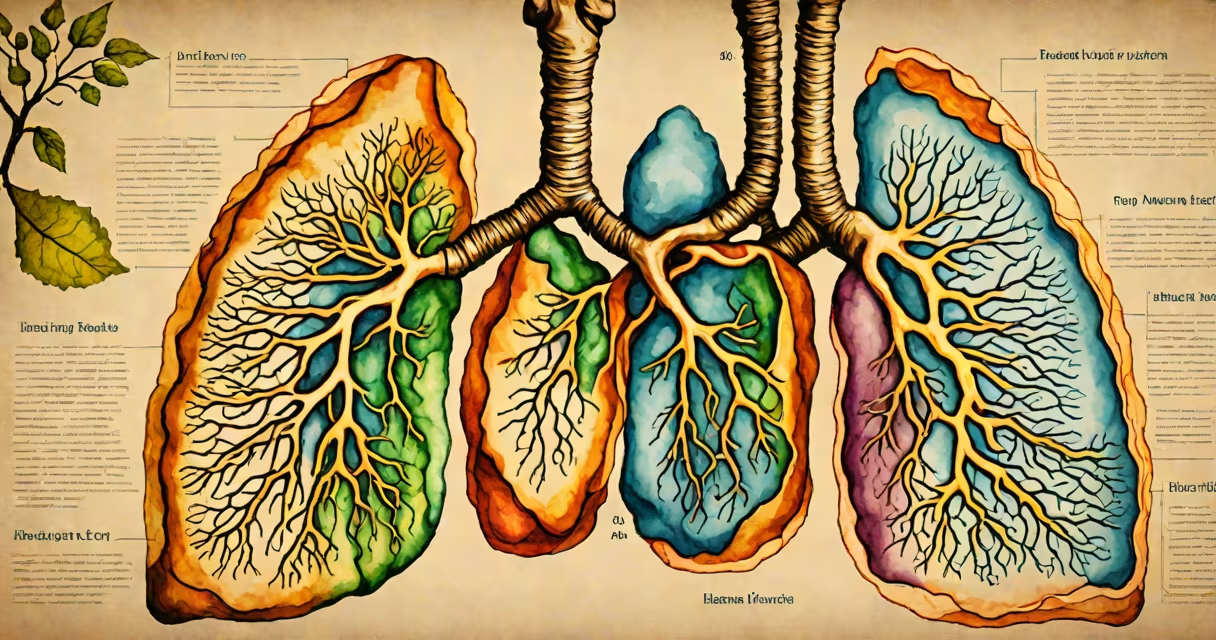
The respiratory system is the network of organs and tissues responsible for gas exchange, primarily oxygen intake and carbon dioxide removal, enabling cellular respiration and sustaining life. It includes the nose, pharynx, larynx, trachea, bronchi, bronchioles, and alveoli, working together to deliver oxygen to the bloodstream and expel waste gases.
When you inhale, air travels through the nasal passages or mouth, down the trachea, and into the bronchi, which branch into smaller bronchioles within the lungs. These terminate in clusters of tiny air sacs called alveoli, where oxygen diffuses into capillaries and binds to hemoglobin in red blood cells. Simultaneously, carbon dioxide from metabolic processes moves from the blood into the alveoli to be exhaled.
Each breath involves coordinated muscle activity. The diaphragm contracts and flattens during inhalation, increasing thoracic volume and lowering pressure. Exhalation is mostly passive, driven by elastic recoil of lung tissue and relaxation of the diaphragm. This process occurs automatically, even during sleep, ensuring continuous oxygen supply to important organs.
Respiratory rate varies with activity level. At rest, adults breathe 12-20 times per minute. During intense exercise, rates can exceed 40 breaths per minute. The system adapts quickly-within seconds-to changes in physical demand, maintaining optimal blood gas levels.
The upper respiratory tract (nose, sinuses, pharynx) filters, warms, and humidifies incoming air. Nasal hairs trap large particles, while mucus and cilia in the respiratory lining sweep smaller contaminants toward the throat for swallowing or expulsion. This defense mechanism prevents pathogens and pollutants from reaching deeper lung tissue.
The lower respiratory tract includes the trachea, bronchi, and lungs. The trachea's C-shaped cartilage rings maintain airway patency. Bronchi branch into 23 generations of progressively narrower tubes, ending in terminal bronchioles. Alveoli-about 300 million in each adult lung-provide a surface area equivalent to a tennis court for gas exchange.
Alveolar walls are just one cell thick, allowing rapid diffusion. Oxygen molecules cross the membrane in milliseconds. Hemoglobin in red blood cells carries up to four oxygen molecules per molecule, enabling efficient transport to tissues throughout the body.
Many assume that breathing is purely mechanical. In reality, it's tightly regulated by the brainstem. The medulla oblongata monitors blood pH and CO₂ levels via chemoreceptors in the carotid bodies and brainstem. If CO₂ rises, breathing accelerates to expel excess gas. This feedback loop maintains acid-base balance.
Another myth is that lungs are spongy and absorb water. In truth, they are highly resilient but fragile. They cannot regenerate damaged tissue effectively. Smoking, pollution, and infections cause permanent scarring and reduced elasticity, leading to conditions like emphysema and pulmonary fibrosis.
Some believe that deep breathing increases oxygen saturation beyond normal levels. While hyperventilation can reduce CO₂ and alter blood pH, it doesn't increase oxygen delivery to tissues. Excessive breathing can lead to dizziness or fainting due to cerebral vasoconstriction.
1. Your lungs have a surface area of roughly 70 square meters-about the size of a tennis court-due to the vast network of alveoli.
2. The average person takes about 20,000 breaths per day. Over a lifetime, that's nearly 700 million breaths.
3. You can hold your breath for up to 2 minutes underwater with training, but most people lose consciousness after 60 seconds due to low oxygen and high CO₂.
4. The right lung has three lobes; the left has two. The heart occupies space in the left chest cavity, reducing lung size on that side.
5. Babies are born with only 10% of their alveoli developed. Full development occurs around age 8.
6. Sneezing can expel air at speeds up to 100 miles per hour, making it one of the fastest biological movements in the human body.
7. The respiratory system helps regulate body temperature. Evaporation of moisture during exhalation cools the body slightly.
8. People who live at high altitudes develop more capillaries in their lungs and higher hemoglobin concentrations to compensate for lower oxygen availability.
9. Smokers lose about 1% of lung function per year. After 20 years, this can result in a 20% decline in forced expiratory volume (FEV1).
10. The nose filters out 90% of airborne particles larger than 10 micrometers before air reaches the lungs.
A trained long-distance runner has a resting tidal volume of 6 liters per breath, compared to 0.5 liters in a sedentary adult. Their important capacity-the maximum air they can exhale after a full inhalation-is typically 6-7 liters, versus 4-5 liters in untrained individuals. This increased capacity results from enhanced diaphragm strength and greater alveolar surface area.
During peak performance, such athletes can achieve minute ventilation exceeding 150 liters per minute-over 10 times the resting rate. Their bodies efficiently extract oxygen and clear CO₂, allowing sustained aerobic metabolism. This efficiency stems from both genetic factors and years of endurance training.