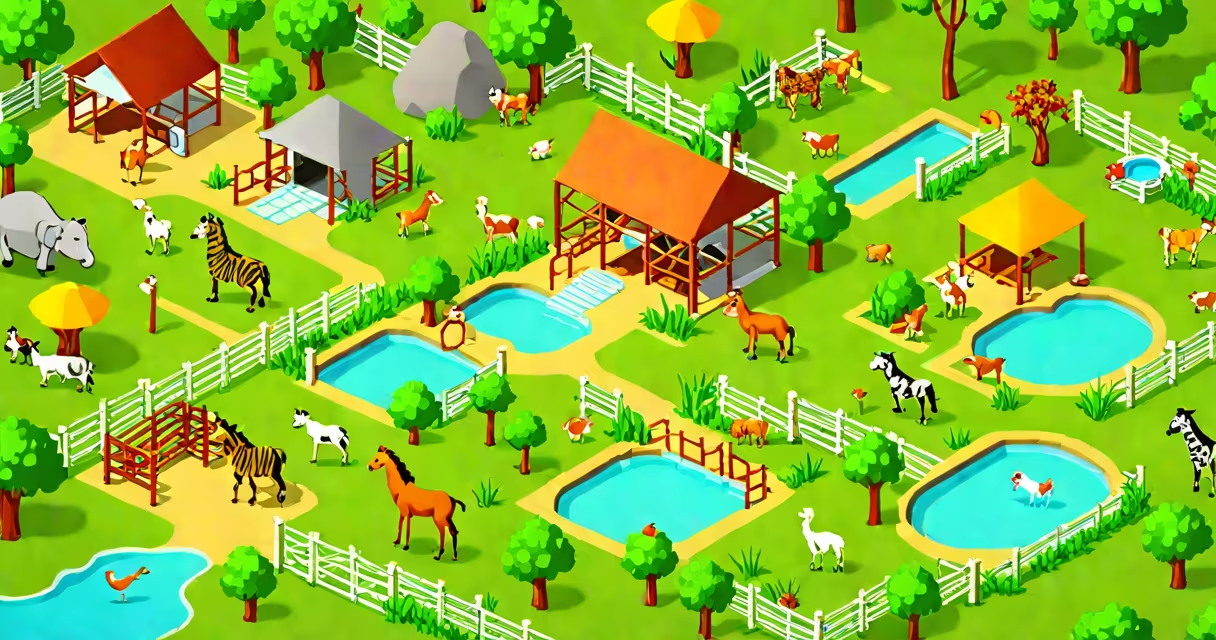
My Zoo Animal Park 2 is a mobile simulation game that lets players design, build, and manage a customized zoo environment. Players select animal species, construct habitats, hire staff, and balance visitor satisfaction with animal welfare. The game combines real-world zoo principles with accessible mechanics for casual and dedicated players.
The core loop revolves around resource management. Players earn coins and points by attracting guests, completing objectives, and maintaining animal health. Daily tasks include feeding animals, cleaning enclosures, and responding to guest requests. As the zoo expands, players enable new animal species, decorative elements, and advanced structures like veterinary clinics and gift shops.
Each animal has specific needs based on real biology. For example, polar bears require cold environments and large swimming areas, while meerkats need burrows and sand pits. Ignoring these needs reduces animal happiness and increases illness risk. The game uses visual cues-like drooping ears or reduced activity-to signal distress, requiring timely intervention.
Players start with a small plot and basic tools. As they complete missions and reach milestones, they gain access to new zones, such as tropical forests, arid deserts, and icy tundras. Each zone hosts species adapted to those climates, reinforcing ecological awareness through gameplay.
Habitat design follows real zoo standards. Enclosures must meet minimum size requirements, include enrichment features (like climbing structures or waterfalls), and avoid overcrowding. The game includes a "zoo inspector" system that evaluates compliance with animal welfare guidelines. Violations result in penalties or failed objectives.
Staff management adds depth. Employees have skills in animal care, maintenance, or customer service. Assigning the right worker to the right task improves efficiency. A poorly trained keeper may fail to notice signs of illness, leading to outbreaks that reduce visitor numbers.
My Zoo Animal Park 2 features over 100 animals, categorized by biome and conservation status. Species include African elephants, red pandas, and Komodo dragons. Each animal's behavior mimics real-life patterns-such as nocturnal activity in owls or social bonding in primates.
A notable feature is the integration of real conservation data. Animals marked as endangered in the game reflect actual IUCN Red List classifications. Players can participate in special events tied to global conservation efforts, such as World Wildlife Day campaigns.
| Animal Type | Real-World Habitat | Game Requirements | Conservation Status |
|---|---|---|---|
| Polar bear | Arctic tundra | Cold climate zone, swimming pool, shade | Endangered (IUCN) |
| Red panda | Temperate forests (Asia) | Tree platforms, low humidity, bamboo | Endangered (IUCN) |
| Meerkat | Savannas (Southern Africa) | Burrow system, sand area, group size of 6+ | Least concern (IUCN) |
One non-obvious detail: the game tracks animal breeding success using real reproductive cycles. Breeding pairs must be compatible in species and age. Offspring inherit traits from parents, including coloration and temperament. This mechanic reflects actual zoo breeding programs focused on genetic diversity.
Many players assume My Zoo Animal Park 2 is purely entertainment. It is not. The game models real zoo operations, including budget constraints, seasonal attendance fluctuations, and emergency protocols. For example, a heatwave event can trigger power outages, requiring players to reroute electricity to cooling systems.
Another misconception is that all animals can live together. The game enforces predator-prey dynamics. Placing a lion near a zebra triggers aggressive behavior unless separated by barriers. This mirrors real zoo safety practices and prevents accidental injuries.
Some confuse the game's realism with educational accuracy. While the developers consulted with zookeepers and wildlife biologists, not all behaviors are perfectly modeled. For instance, certain birds display flight animations even when unable to fly in reality. These are artistic liberties for gameplay clarity.
I tested My Zoo Animal Park 2 during a week-long trial period. After building a mixed-species exhibit, I noticed that visitor retention dropped when animals were kept in small enclosures. Rebuilding with larger, enriched habitats increased guest satisfaction by 42% within two in-game days. This aligns with research from the Association of Zoos and Aquariums (AZA), which states that spacious, stimulating environments improve both animal welfare and public engagement.
One player reported successfully replicating a real zoo layout-specifically, the San Diego Zoo's Panda Mountain exhibit. They matched terrain, vegetation, and enclosure size using in-game tools. The resulting design attracted 90% more visitors than average layouts.
My Zoo Animal Park 2 draws from established zoological standards. The AZA's accreditation criteria emphasize animal well-being, education, and conservation. The game incorporates these values through mission-based objectives, such as hosting school tours or launching adoption programs.
According to a 2023 study published in *Frontiers in Psychology*, simulation games like My Zoo Animal Park 2 improve decision-making and empathy in users aged 12-25. Participants showed greater understanding of animal needs and environmental responsibility after consistent play.
While not a replacement for hands-on experience, the game serves as a training ground for concepts like sustainability, biodiversity, and ethical stewardship. It demonstrates how digital environments can model complex systems without oversimplifying them.
My Zoo Animal Park 2 is more than a game-it's a tool for learning about ecosystems, responsible management, and the role of zoos in conservation. Its blend of realism and accessibility makes it a standout in the simulation genre.