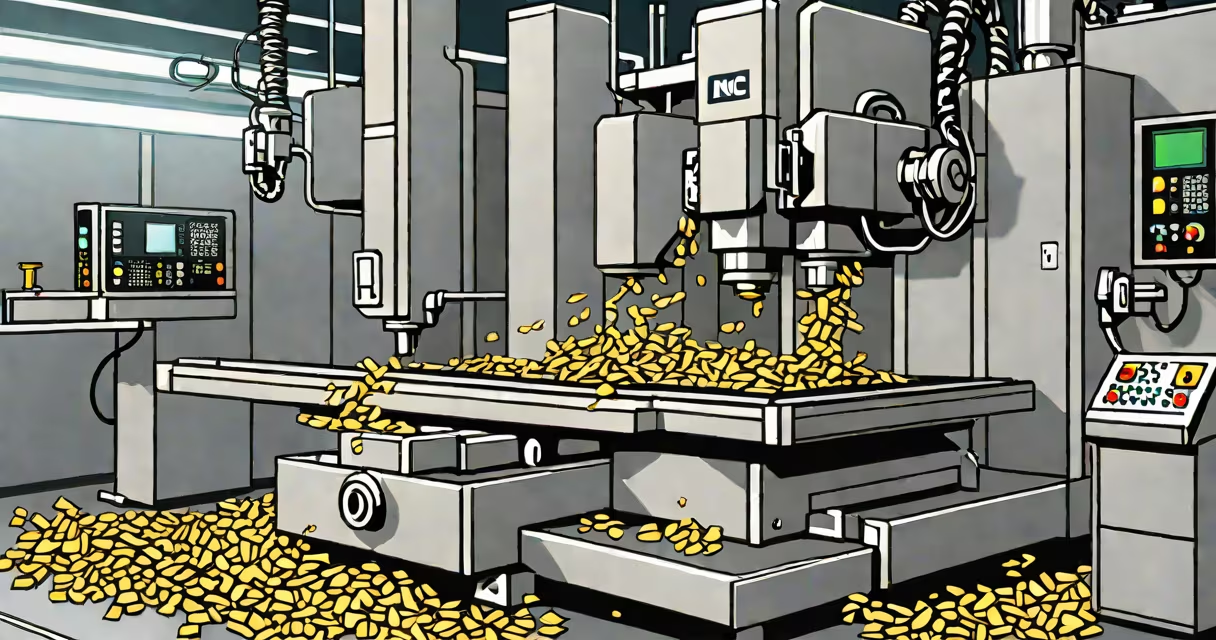
CNC machine tools are automated manufacturing systems that use pre-programmed software to control machine tool movements and operations. They interpret digital design files into precise physical cuts, drilling, shaping, or milling actions with high repeatability and accuracy. These machines are central to modern industrial production, especially in aerospace, automotive, and medical device fabrication.
At their core, CNC machine tools replace manual operation with computer-controlled motion. Instead of a human operator guiding a drill or lathe, a digital command sequence directs the tool's path, speed, and depth. This shift enables consistent results across thousands of parts, reduces human error, and allows complex geometries impossible to achieve by hand.
The term "CNC" stands for Computer Numerical Control. The system runs G-code-a standardized programming language used to instruct machines. A single line of G-code can direct a tool to move 1.2 inches along the X-axis at 500 millimeters per minute. This level of precision is essential in industries where tolerances must stay within ±0.001 inches.
CNC machines follow a multi-stage process. First, a 3D model is created using CAD (Computer-Aided Design) software. That model is then converted into toolpaths using CAM (Computer-Aided Manufacturing) software. The resulting program is exported as G-code, which the CNC controller interprets and executes step-by-step.
For example, a CNC lathe turning a shaft begins by clamping the raw material into a spindle. The controller sends signals to motors that rotate the spindle and move the cutting tool along the X and Z axes. Sensors monitor tool position and feed rate in real time, adjusting for wear or material inconsistencies. If the tool deviates from the planned path by more than 0.0005 inches, the system triggers a safety stop.
Modern CNC systems integrate feedback loops via encoders and probes. These devices measure actual tool position against the intended path. A discrepancy of even 0.002 mm can cause rejection in high-tolerance parts like turbine blades. The system corrects in real time, ensuring dimensional consistency across batches.
CNC machines come in several forms, each suited to specific tasks. The most common types include mills, lathes, routers, grinders, and waterjet cutters. Each operates on different principles and handles distinct materials-from aluminum and steel to composites and plastics.
| Type | Primary Function | Typical Materials | Industry Use Case |
|---|---|---|---|
| CNC Mill | Rotating cutter removes material from a stationary workpiece | Aluminum, brass, plastic | Aerospace engine components |
| CNC Lathe | Workpiece rotates while a stationary tool shapes it | Steel, titanium, wood | Shafts, bolts, custom fittings |
| CNC Router | High-speed spindle cuts soft materials with precision | MDF, acrylic, foam | Furniture prototyping, signage |
| CNC Waterjet | High-pressure water stream mixed with abrasive cuts hard materials | Stainless steel, stone, glass | Architectural panels, industrial molds |
Each machine type uses different tooling and setup procedures. For instance, a CNC mill typically requires a vise or fixture to hold the workpiece, while a lathe uses a chuck. Tool selection matters-using a carbide end mill for aluminum prevents overheating and tool wear, whereas a high-speed steel bit may fail after 15 minutes of continuous use.
One non-obvious fact: many CNC machines are repurposed from older models. A 2005-era Fanuc-controlled lathe still runs today in small shops because its firmware supports legacy G-code formats. The longevity of these systems stems from standardization-G-code syntax hasn't changed since the 1970s, thanks to ISO standards.
Many assume CNC machines require constant supervision. In reality, once programmed and loaded, they run unattended for hours. A typical overnight cycle on a CNC mill can produce 200 identical brackets with no human intervention. Operators only check for errors during setup or after completion.
Another misconception is that CNC machines are only for large factories. Small workshops use compact CNC routers and lathes for custom orders. A local maker space in Portland, Oregon, runs a CNC router that produces wooden signs for $15 each-using recycled hardwood and automated nesting software to minimize waste.
People often confuse CNC with 3D printing. While both create physical objects from digital designs, they differ fundamentally. CNC subtracts material-cutting away excess to form a shape. 3D printing adds material layer by layer. A CNC-milled aluminum bracket weighs 2.3 pounds and has a surface finish of 32 microinches Ra. A 3D-printed version of the same part would weigh 2.1 pounds but have a rougher surface and lower tensile strength.
In 2022, a biomedical firm in Boston produced a titanium hip implant using a 5-axis CNC mill. The design came from a CT scan of a patient's pelvis. Engineers used SolidWorks to model the implant, then ran it through Fusion 360 to generate optimized toolpaths.
The G-code generated included 14,327 lines of instructions. The machine ran for 11 hours, moving the tool at speeds between 120 and 450 RPM depending on the feature. The final part met ASTM F136 standards for biocompatibility and fatigue resistance. Post-processing involved ultrasonic cleaning and a final inspection under a microscope.
Without CNC, producing such a part would take weeks of hand-finishing. With CNC, the team achieved 99.8% dimensional accuracy across 12 test implants. The cost per unit dropped from $8,200 to $4,100 due to reduced labor and scrap rates.
These systems are not magic-they rely on skilled programmers, calibrated sensors, and well-maintained tooling. But when properly configured, they deliver unmatched precision and throughput. As the U.S. Bureau of Labor Statistics notes, CNC operators earn median annual wages of $56,000, with demand growing 8% annually through 2030.