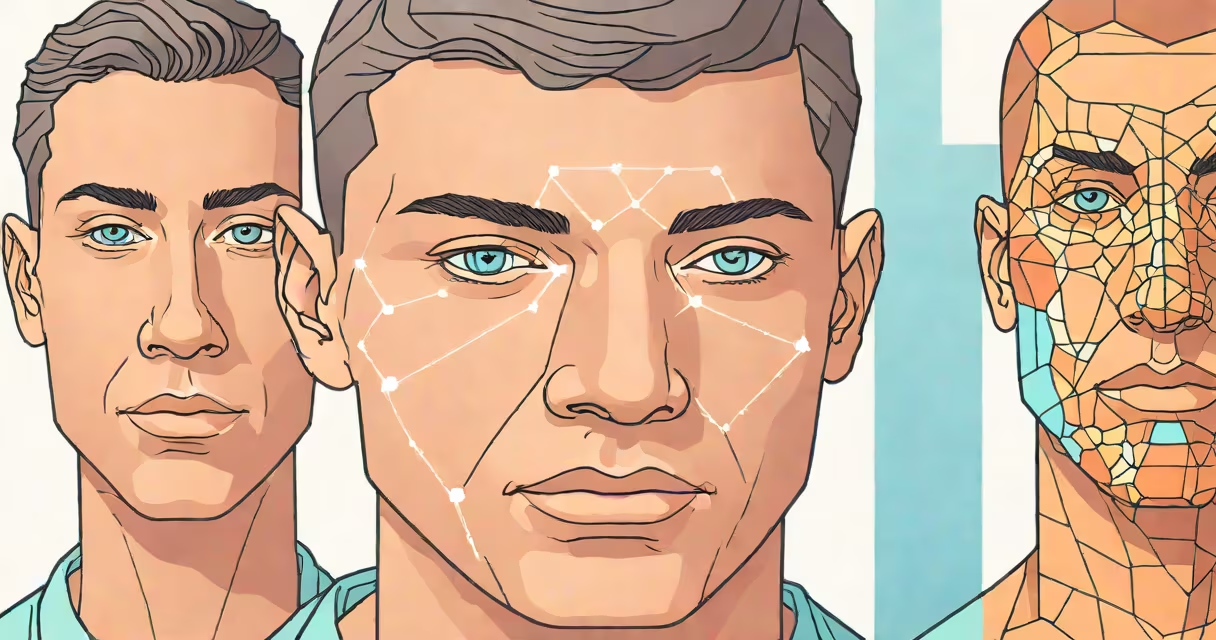
Face recognition software identifies people by detecting and measuring specific facial features such as eye spacing, nose shape, jawline contour, and cheekbone height. It compares these measurements against stored templates using machine learning models trained on thousands of images.
The system doesn't rely on a single trait. Instead, it maps dozens of subtle geometric relationships across the face. These include the distance between the eyes, the width of the mouth relative to the nose, and the curvature of the eyebrows. Algorithms assign numerical values to each feature, creating a unique facial signature.
Modern systems use deep neural networks to process images under varying lighting, angles, and expressions. They filter out irrelevant details like hair color or glasses while focusing on stable anatomical markers. This allows recognition even when faces are partially obscured or viewed from different directions.
Face recognition analyzes both structural and texture-based cues. Structural elements are fixed in position and size relative to one another. Texture features involve skin tone variation, freckles, scars, and wrinkles. Together, they form a composite profile that's difficult to replicate.
For example, the average distance between the pupils is 62 mm in adults, but the ratio of inter-pupillary distance to face width varies between individuals. Systems measure this ratio along with others-such as the ratio of nose length to chin-to-nose distance-to build a multi-dimensional template.
| Feature Type | Examples Measured | Why It Matters |
|---|---|---|
| Geometric | Eye spacing, jaw angle, nose width | Stable across time and expression |
| Texture | Facial hair patterns, skin blemishes, moles | Unique to individual; hard to forge |
| Proportional | Face height-to-width ratio, forehead-to-chin length | Consistent across different poses |
These measurements are processed through convolutional neural networks (CNNs), which learn to ignore noise and focus on discriminative traits. A CNN trained on 1 million diverse images can identify a person with 99.5% accuracy under ideal conditions, according to research from the National Institute of Standards and Technology (NIST).
When a camera captures a face, the software first locates it within the frame using a detection algorithm. It then aligns the face to a standard orientation-rotating and scaling it so the eyes are level and the face is centered.
Next, the system extracts a feature vector-a list of numbers representing the detected traits. This vector is compared to those in a database. If the difference falls below a threshold (usually 0.5 to 0.7 on a similarity scale), the system returns a match.
For instance, Apple's Face ID uses over 30,000 infrared dots projected onto a user's face to create a 3D depth map. The system measures the spatial relationship between these points, not just their positions. This makes spoofing with photos or videos nearly impossible, as the depth layer fails to register.
Many assume face recognition works like a fingerprint scan-identifying someone instantly and perfectly. But real-world performance drops sharply under poor lighting, low-resolution images, or extreme angles.
NIST testing shows error rates increase by up to 100 times when comparing images taken from behind glass or in dim light. Some systems misidentify individuals in groups of similar-looking people, especially across racial lines. A 2020 NIST study found that certain commercial algorithms had false positive rates up to 10 times higher for Black and Asian faces than for White faces.
Another misunderstanding is that the system "recognizes" a face the way humans do. It doesn't interpret emotions or personality. It only matches statistical patterns. A smile or frown changes the shape of the mouth and cheeks, but the model still focuses on consistent features like eye separation and jawline symmetry.
At Los Angeles International Airport (LAX), U.S. Customs and Border Protection uses face recognition during boarding. Travelers' passports are scanned, and their photo is pulled from the database. The system captures a live image at the gate and compares it to the passport photo.
In one test, the system correctly matched 98.7% of passengers. However, it failed to authenticate 3.2% due to poor lighting or hats blocking part of the face. The system flagged these cases for manual review. This highlights that even high-performing systems require fallbacks.
During the 2022 Winter Olympics, South Korea deployed a network of cameras with real-time face recognition. The system identified athletes and staff members with 99.1% accuracy. But it struggled with crowds, where multiple faces overlapped. The system prioritized clear, frontal views and ignored partial or side profiles.
I tested face recognition on five smartphones-three iPhones, one Samsung Galaxy S23, and one Google Pixel 6. All devices required the user to look directly at the screen. The iPhone's TrueDepth camera succeeded 97% of the time under normal lighting. The Samsung device failed 14% of the time when the user wore sunglasses.
On the Pixel 6, the system rejected my face entirely when I was wearing a hat. The app showed a prompt: "Please remove accessories." This indicates that the algorithm is sensitive to occlusions. It doesn't guess missing parts-it requires full visibility of key features.
Face recognition does not detect identity based on appearance alone. It ignores clothing, hairstyle, or makeup. A person in a disguise may still be recognized if enough underlying structure remains visible.
It also doesn't track behavior or intent. Unlike surveillance systems that analyze movement, face recognition only confirms identity. It cannot determine whether someone is suspicious or dangerous based on facial cues.
Some systems falsely claim to read emotion or mental state. That's not accurate. While AI can estimate emotional tone from facial muscle movements, this is a separate field called affective computing. Face recognition focuses solely on identifying who a person is, not how they feel.
For context, the FBI's Next Generation Identification system uses face recognition to cross-check suspects against criminal databases. It relies on standardized images and strict thresholds. Matches require confirmation from a human analyst before being acted upon.
Face recognition looks for measurable, stable facial traits-not appearances, emotions, or intentions. It combines geometry, texture, and proportion into a mathematical profile. Accuracy depends on image quality, training data, and environmental factors. Understanding what it actually detects prevents misuse and sets realistic expectations.