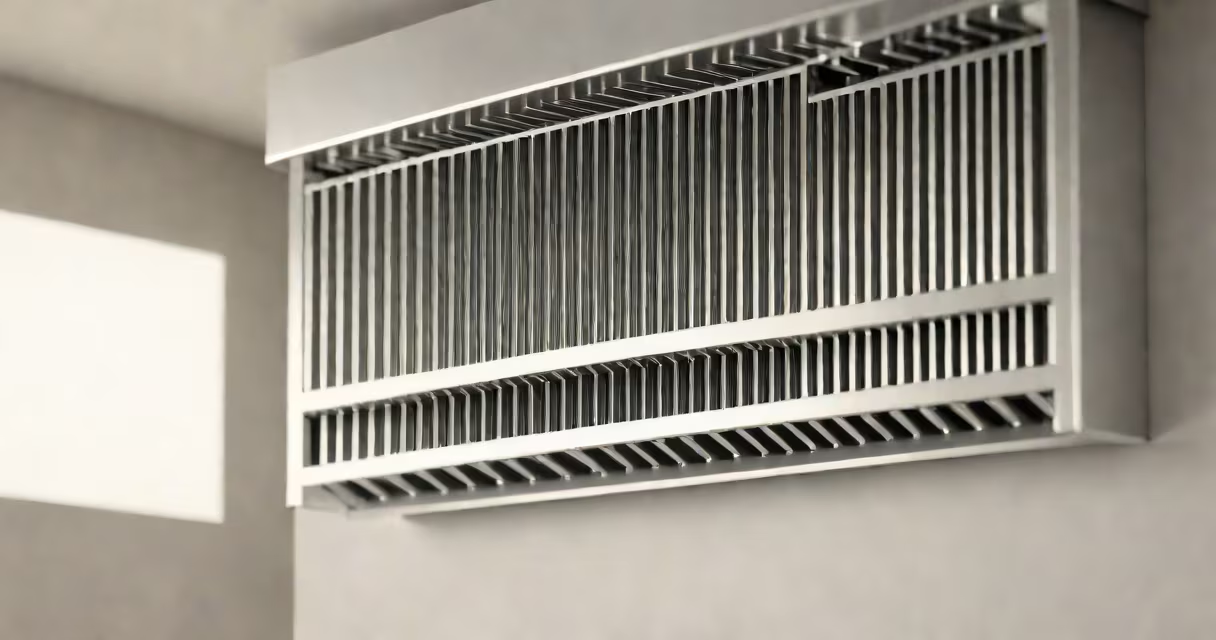
Forced air in a house is a heating and cooling system that moves conditioned air through a network of ducts using a blower fan. It's the most common HVAC method in U.S. homes, delivering temperature control via centralized units.
The system draws air from rooms through return grilles, passes it through a furnace or air handler, heats or cools it, then pushes it back into the home through supply vents. This process maintains consistent indoor temperatures and supports humidity control when paired with a dehumidifier or humidifier.
According to the U.S. Department of Energy, over 60% of U.S. homes use forced air systems, primarily because they integrate easily with central air conditioners and gas furnaces. The system's efficiency depends on duct sealing, insulation, and proper sizing.
A forced air system relies on a central unit-either a furnace for heating or an air handler with a cooling coil for air conditioning-to condition air. A blower fan pulls indoor air through return ducts into the unit, where it passes over heat exchangers or cooling coils.
When heating, the furnace burns fuel (natural gas, oil, or propane) or uses electric elements to warm the air. For cooling, refrigerant in the evaporator coil absorbs heat from the air, lowering its temperature. The conditioned air then travels through supply ducts and exits through floor, wall, or ceiling vents.
Thermostats regulate the system by signaling when to turn on or off based on set temperature. Modern systems include variable-speed blowers and smart thermostats that adjust airflow dynamically to reduce energy waste.
Forced air systems consist of several core parts:
| Component | Purpose | Common Failure Point |
|---|---|---|
| Furnace or air handler | Heats or cools air | Blower motor failure, cracked heat exchanger |
| Ductwork | Transports air throughout the house | Leakage, poor insulation, blockages |
| Thermostat | Controls system activation | Incorrect calibration, dead batteries |
| Supply and return vents | Intake and release points for air | Blocked by furniture, dust buildup |
Forced air systems come in two primary configurations: gas furnace with AC, or electric furnace with heat pump. Gas systems typically deliver higher BTU output and lower operating costs in cold climates. Electric systems work well in milder regions but cost more to run during winter.
Some homes use dual-fuel setups-gas furnace for heating, electric heat pump for cooling-maximizing efficiency across seasons. The EPA notes that properly sized and sealed ducts can improve system efficiency by up to 30%.
Forced air is standard in new construction and major renovations due to its compatibility with zoning controls, air filtration, and integration with smart home systems. It allows homeowners to set different temperatures in different zones using dampers and multiple thermostats.
It's especially effective in large homes with multiple floors. A single furnace can serve the entire structure, reducing equipment redundancy. Ducts can be routed through attics, basements, or crawlspaces, though poorly insulated ducts in unconditioned spaces lose up to 20% of heating or cooling capacity.
One non-obvious fact: ducts aren't just passive pipes-they act as air filters. Many systems include MERV-rated filters that trap dust, pollen, and pet dander. Replacing a filter every 1-3 months reduces allergens and improves airflow. The American Lung Association recommends MERV 8-13 filters for better indoor air quality.
Forced air is often mistaken for radiant heating or baseboard heaters. Radiant systems warm surfaces via infrared or hot water tubes, while forced air moves air directly. They're not interchangeable-radiant systems don't use ducts or fans.
Another confusion: people assume forced air systems cool faster than other methods. In reality, cooling speed depends on airflow volume and temperature differential. A high-velocity system may feel cooler quickly, but it doesn't remove heat faster than a properly balanced system.
I once replaced a thermostat in a 1980s home where the furnace ran constantly. The issue wasn't the thermostat-it was a disconnected return duct behind a closet. Air couldn't circulate, so the system kept trying to cool a space that had no intake. Sealing the duct and cleaning the filter fixed it in under two hours.
Forced air systems struggle in homes with tight layouts or limited attic/crawl space. Ducts require 6-12 inches of clearance, which may not exist in older homes. Retrofitting ductwork can cost $5,000-$10,000, making alternatives like mini-split heat pumps more practical.
People with severe allergies may find forced air problematic. Dust and debris accumulate in ducts and circulate with every cycle. The CDC reports that improperly maintained ducts can harbor mold and bacteria, worsening respiratory conditions.
Forced air remains the dominant HVAC solution in American homes due to its scalability, integration with existing infrastructure, and ability to support whole-home climate control. Its performance hinges on correct installation, regular maintenance, and attention to duct integrity.