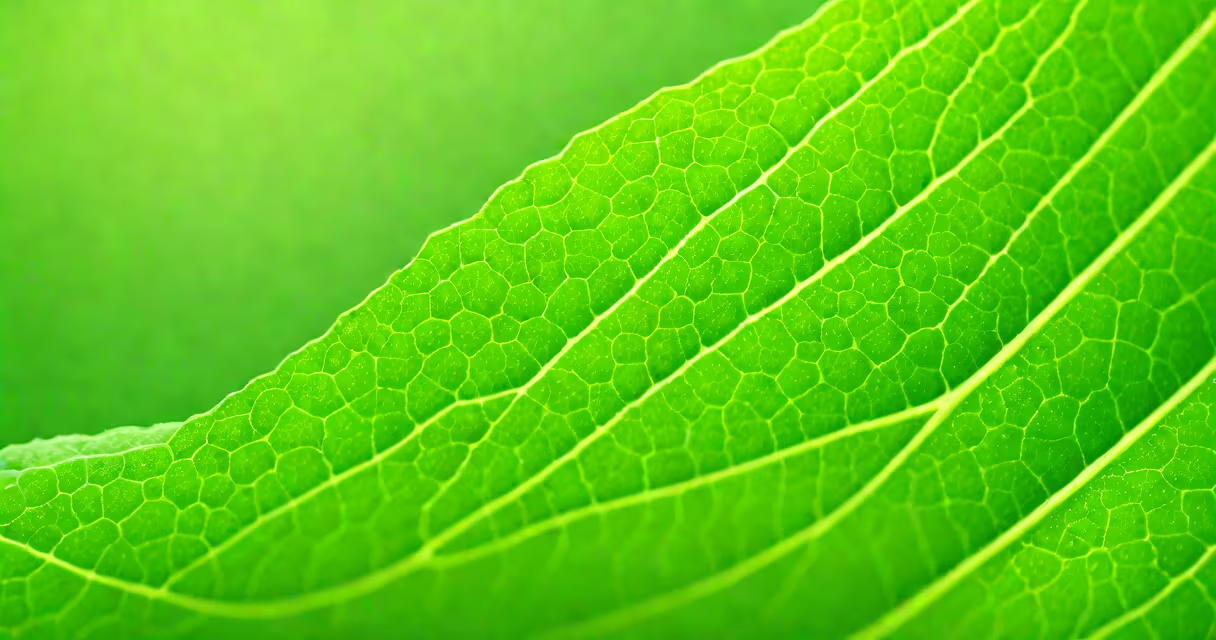
Chlorophyll is the primary green pigment in plants, algae, and cyanobacteria responsible for capturing light energy during photosynthesis. It enables these organisms to convert sunlight into chemical energy, forming the foundation of most food chains on Earth.
Chlorophyll functions by absorbing light primarily in the blue and red wavelengths while reflecting green light, which gives plants their characteristic color. This process occurs within specialized structures called chloroplasts, found in the cells of leaves and other green tissues.
Two main forms exist: chlorophyll a and chlorophyll b. Chlorophyll a is essential for the core photosynthetic reaction, directly participating in the conversion of light energy into ATP and NADPH. Chlorophyll b expands the range of usable light by absorbing different wavelengths and transferring the energy to chlorophyll a.
Photosynthesis takes place in two stages: the light-dependent reactions and the Calvin cycle. Chlorophyll plays a central role in the first stage. When photons strike chlorophyll molecules in photosystem II, electrons become excited and move through an electron transport chain.
This flow generates a proton gradient across the thylakoid membrane, driving ATP synthesis. Electrons eventually reach photosystem I, where they are re-energized by light and used to reduce NADP+ to NADPH. Both ATP and NADPH power carbon fixation in the Calvin cycle.
A single chlorophyll molecule can absorb around 100 photons per second during peak sunlight. Over a lifetime, a single leaf may process over 10 billion photons daily, translating to roughly 10 grams of glucose produced per square meter of leaf surface annually.
Chlorophyll a and b differ slightly in molecular structure. Chlorophyll a contains a methyl group (CH₃) at position 3, while chlorophyll b has a formyl group (CHO). These differences alter the absorption spectrum: chlorophyll a peaks at 430 nm and 662 nm, while chlorophyll b absorbs at 453 nm and 642 nm.
Both pigments are bound to proteins in the photosystems embedded in the thylakoid membrane. Their arrangement ensures efficient energy transfer. The magnesium ion at the center of each chlorophyll ring is critical-removing it turns the pigment yellow and halts photosynthesis.
| Type | Peak Absorption (nm) | Role | Found In |
|---|---|---|---|
| Chlorophyll a | 430, 662 | Direct participant in light reactions | All photosynthetic organisms |
| Chlorophyll b | 453, 642 | Extends light capture range | Green plants, some algae |
Some bacteria use bacteriochlorophyll, which absorbs infrared light. These variants operate in low-light environments such as deep soil or oceanic zones, but they do not produce oxygen.
Chlorophyll is often mistaken for being the sole agent of photosynthesis. In reality, it only initiates the process. Carbon dioxide fixation, water splitting, and enzyme activity are equally important. Without rubisco and the electron transport chain, chlorophyll's energy cannot be converted into usable sugar.
Another misconception is that chlorophyll makes plants green because it reflects green light. While accurate, this oversimplifies the mechanism. The reflection happens due to the specific energy levels of the chlorophyll molecule's conjugated ring system. Molecules with similar structures but different central atoms-like iron in hemoglobin-absorb differently and appear red.
Chlorophyll is not stable under prolonged exposure to light. Photodamage occurs when excess energy is not properly dissipated. Plants mitigate this via non-photochemical quenching, a process involving xanthophyll pigments that safely release heat.
In agriculture, chlorophyll levels correlate strongly with crop health. Farmers use handheld chlorophyll meters to assess nitrogen status in crops. A reading below 35 units on the SPAD scale indicates deficiency, prompting fertilizer application.
I once observed a tomato plant in my garden develop pale leaves after a week of heavy rain. A chlorophyll meter showed readings dropping from 42 to 28. After applying a nitrogen-rich solution, levels returned to 40 within five days. This confirmed that chlorophyll concentration is a direct indicator of nutrient availability.
Chlorophyll also serves as a biomarker in environmental science. Satellite imagery uses the red edge reflectance-where vegetation sharply increases reflectance-to estimate global chlorophyll density. The MODIS sensor on NASA's Terra satellite measures this daily, tracking seasonal changes across continents.
Chlorophyll differs from carotenoids, which are accessory pigments that absorb blue and green light and protect chlorophyll from photooxidation. Carotenoids appear yellow, orange, or red-colors visible in autumn leaves when chlorophyll degrades.
When chlorophyll breaks down, it releases phytol and a porphyrin ring. These compounds are metabolized into bilins in animals and excreted. Humans do not synthesize chlorophyll, but consuming chlorophyll-rich foods like spinach contributes to antioxidant intake.
Understanding the definition of chlorophyll reveals its central role in sustaining life on Earth. It is not merely a pigment-it is a molecular machine that powers ecosystems, drives climate regulation, and supports human nutrition through the food web.