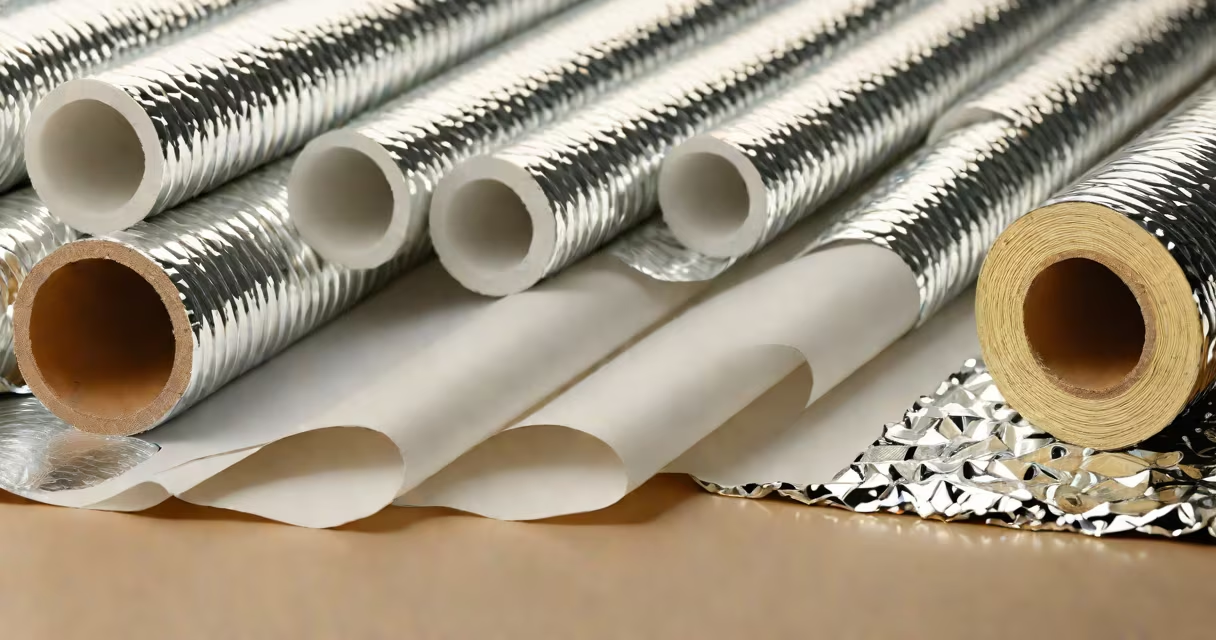
A good insulator of heat resists the flow of thermal energy, minimizing heat transfer through conduction. Materials with low thermal conductivity-typically below 0.1 W/m·K-are effective at maintaining temperature differences, such as in building walls, refrigerators, and clothing.
Heat moves through solids via atomic vibrations and electron movement. Insulators disrupt this process by containing trapped air or gas pockets, using complex molecular structures that impede energy transfer. The effectiveness of a material depends on its composition, density, and structure-not just its appearance.
For example, a 2-inch thick layer of polyisocyanurate foam has a thermal resistance (R-value) of about 15, while the same thickness of fiberglass batts provides around R-11. This difference arises from how tightly the material traps air-foam's closed-cell structure reduces convective heat loss more effectively than open-cell fiberglass.
Insulation slows heat transfer by reducing conduction, convection, and radiation. Conduction occurs when molecules collide and pass kinetic energy. In insulating materials, long-chain polymers or porous networks limit this interaction. Air trapped in tiny cells acts as a poor conductor-air has a thermal conductivity of 0.026 W/m·K, much lower than most solids.
Convection is minimized when air movement is restricted. Closed-cell foams prevent internal airflow, while loose-fill materials like cellulose rely on fiber entanglement to block circulation. Radiation is reduced by reflective surfaces-aluminum foil layers in radiant barriers reflect up to 97% of infrared energy.
When installing insulation, gaps greater than 1/8 inch can reduce performance by up to 50%, according to the U.S. Department of Energy. Even small voids allow convective loops to form, undermining the material's intended function.
Several materials stand out due to their low thermal conductivity and practical use in construction, industrial systems, and consumer products. The table below compares common insulating materials based on measured thermal conductivity at room temperature.
| Material | Thermal Conductivity (W/m·K) | Typical R-value per inch | Primary Use |
|---|---|---|---|
| Aerogel | 0.010-0.015 | 10-15 | High-performance aerospace, cryogenic systems |
| Polyisocyanurate foam | 0.020-0.025 | 6.0-7.0 | Roofing, wall sheathing |
| Fiberglass batts | 0.035-0.045 | 3.0-4.0 | Residential wall and attic insulation |
| Cellulose (recycled paper) | 0.038-0.042 | 3.2-3.8 | Attic fills, retrofitting older homes |
| Expanded polystyrene (EPS) | 0.033-0.035 | 3.6-4.0 | Foundation insulation, packaging |
Aerogel is the most effective known solid insulator, with a density less than that of air. Despite its high cost, it's used in space suits and satellite components where weight and performance are critical. A 1 cm layer of aerogel can provide the same thermal resistance as 10 cm of fiberglass.
Some materials perform better under specific conditions. For example, mineral wool maintains stability at temperatures above 1,000°C, making it ideal for fire-rated walls. In contrast, expanded polystyrene degrades above 75°C and is unsuitable for high-heat environments.
Many assume that thicker insulation always performs better. However, beyond a certain point, diminishing returns set in. Adding a second layer of fiberglass to an R-11 wall increases resistance by only ~10%-not double-due to interface losses and compression effects.
Another error is equating "insulating" with "thermal mass." Materials like concrete or brick store heat well but conduct it rapidly. They're poor insulators despite being used in passive solar design. Thermal mass delays temperature changes; insulation prevents them entirely.
Some consumers believe that fluffy, soft materials are inherently better insulators. But a dense, compacted layer of cellulose can outperform a loosely packed one-even if both appear similar. Proper installation pressure matters. The U.S. Environmental Protection Agency notes that improper installation accounts for 30% of insulation failures in homes.
Consider a single-story home in Duluth, Minnesota, with a 2,000 sq ft floor area. The goal is to maintain indoor temperatures between 68°F and 72°F during winter months with minimal heating demand.
The builder selects rigid foam board (polyisocyanurate) with an R-value of 6.5 per inch for the exterior walls and roof. Using 4 inches of foam gives an R-value of 26-well above the minimum required by the International Energy Conservation Code (IECC) for Climate Zone 7.
Inside, fiberglass batts (R-13) fill the wall cavities. Combined, the wall assembly achieves R-39. Without proper vapor barriers, moisture can condense within the insulation, reducing its effectiveness by up to 50%. The installer includes a polyethylene vapor barrier on the interior side to prevent this.
After one heating season, the homeowner reports a 40% reduction in gas usage compared to the previous year. The system works because the combination of high-R-value materials and correct installation limits heat loss through conduction and convection.
Even a small gap-like a 1/4-inch hole around a window frame-can increase heat loss by 15%. Sealing all joints and penetrations is essential. The U.S. Department of Energy estimates that sealing air leaks saves 10-20% on heating costs, often more than upgrading insulation alone.
Materials with low thermal conductivity-such as aerogel, polyisocyanurate foam, and properly installed fiberglass-are among the best insulators of heat. Their effectiveness depends on installation quality, thickness, and environmental conditions. Always consult standards like the IECC or ASHRAE 90.1 for application-specific guidance.