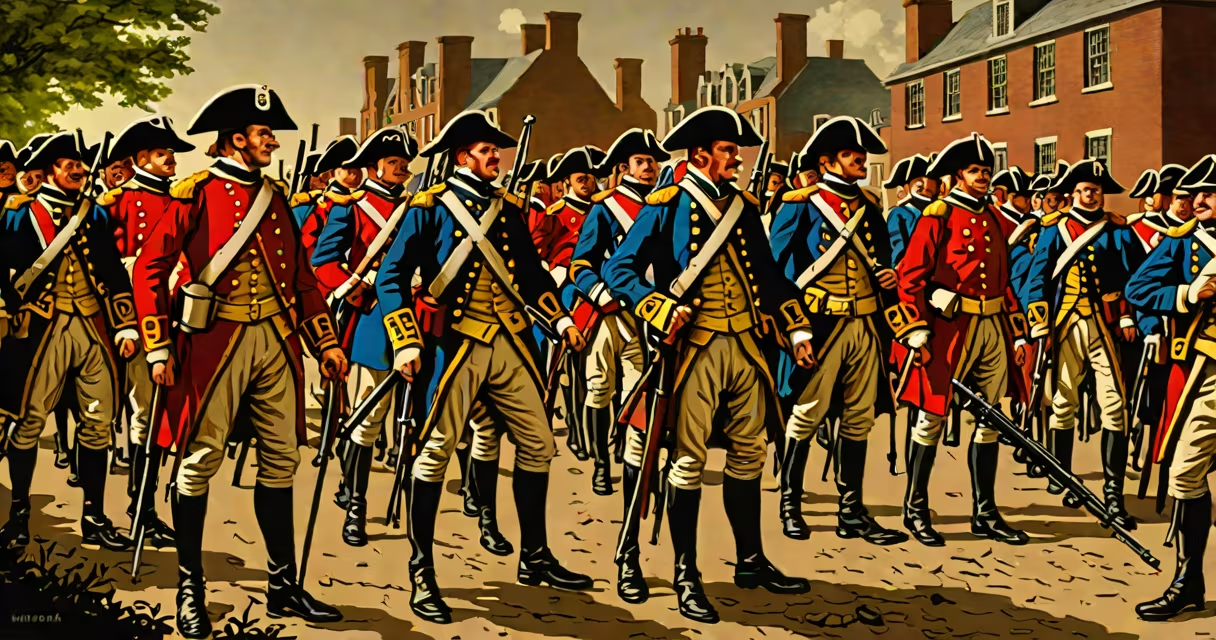
The Intolerable Acts were a series of four punitive laws enacted by the British Parliament in 1774 in response to the Boston Tea Party. These laws targeted Massachusetts specifically, aiming to punish colonists and reassert imperial authority. They marked a turning point in Anglo-American relations, pushing colonies toward unified resistance.
Passed between March and June 1774, the acts were officially called the Coercive Acts by the British government. Colonists referred to them as the Intolerable Acts because they viewed the measures as unjust and oppressive. The laws dismantled local governance, restricted trade, and imposed military rule in Boston. Their passage triggered immediate backlash across the Thirteen Colonies.
Each act addressed a specific grievance following the destruction of tea in Boston Harbor. The British believed that economic pressure and military enforcement would restore order. Instead, the acts united colonists who had previously debated independence. They led to the convening of the First Continental Congress and set the stage for armed conflict.
The four laws functioned as coordinated tools of coercion. They targeted Massachusetts' political and economic infrastructure to force compliance. The British assumed that isolating Boston would weaken colonial opposition. Instead, it galvanized support for Massachusetts and created a network of mutual aid among colonies.
The Boston Port Act closed the port of Boston until the destroyed tea was paid for. This meant ships could not enter or leave the harbor. The economic impact was immediate: merchants lost income, dockworkers faced unemployment, and food supplies dwindled. By May 1774, Boston's economy had stalled. The British expected this hardship to pressure colonists into accepting royal authority.
The Massachusetts Government Act replaced the elected colonial assembly with a council appointed by the Crown. Town meetings required royal permission to convene. This dismantled representative institutions and removed local control. The law effectively outlawed self-governance in Massachusetts, replacing it with direct imperial oversight.
The Administration of Justice Act allowed royal officials accused of crimes to be tried in Britain or another colony. This protected British agents from colonial juries, which many saw as a denial of due process. The act undermined the principle of trial by peers-a foundational legal right in English common law.
The Quartering Act extended the requirement for colonists to house British troops. Unlike previous versions, this law applied to all colonies and allowed troops to occupy private homes without consent. It violated property rights and intensified resentment toward military presence.
A table outlines the four acts, their official names, and their impacts:
| Act | Official Name | Key Provisions | Colonial Reaction |
|---|---|---|---|
| Boston Port Act | Trade and Navigation Act | Closed Boston Harbor until tea reparations were paid | Massachusetts declared it illegal; led to widespread boycotts |
| Massachusetts Government Act | Government Act of 1774 | Replaced elected assembly with Crown-appointed council | Triggered town meeting protests; inspired intercolonial solidarity |
| Administration of Justice Act | Justice Act | Allowed royal officials to be tried outside Massachusetts | Viewed as undermining jury trials; seen as judicial corruption |
| Quartering Act | Quartering Act of 1774 | Required colonists to house British soldiers in private homes | Violated privacy and property rights; fueled anger |
These laws did not operate in isolation. The combination of economic blockade, political suppression, judicial bias, and forced military housing created a system designed to break colonial autonomy. The cumulative effect was a crisis of legitimacy. Colonists questioned whether Britain still represented their interests.
One non-obvious fact: the Quartering Act of 1774 was the first to apply uniformly across all colonies. Earlier versions had been limited to specific regions. This expansion signaled a shift from localized punishment to systemic control. It also exposed the fragility of colonial trust in British promises of fair treatment.
The British government passed the Intolerable Acts in London, under the authority of King George III and Parliament. The goal was to reestablish control after the Boston Tea Party, which occurred on December 16, 1773. Colonists had dumped 342 chests of tea-worth £10,000 at the time-into Boston Harbor to protest the Tea Act.
Parliament justified the acts as necessary to maintain order and uphold the rule of law. Officials argued that colonial defiance required a firm response. But the acts ignored colonial representation and legal tradition. The lack of consultation with colonial assemblies made the laws appear arbitrary and authoritarian.
Colonists responded with coordinated resistance. Virginia's House of Burgesses issued a call for a continental congress. New York, Pennsylvania, and South Carolina sent delegates. The First Continental Congress met in Philadelphia in September 1774. Delegates agreed to boycott British goods and form militias. They also drafted the Declaration of Rights and Grievances, asserting colonial rights under the Magna Carta and English Bill of Rights.
When British troops arrived in Boston in October 1774, they found the city under siege by civilian resistance. Local leaders organized patrols and distributed supplies. The situation escalated quickly. By April 1775, fighting broke out at Lexington and Concord-the first battles of the Revolutionary War.
Many assume the Intolerable Acts were a single law. They were not. They were four distinct pieces of legislation passed separately. Confusing them as one measure distorts their strategic intent. Each targeted a different aspect of colonial life: trade, governance, justice, and military housing.
Another misconception is that the acts were universally supported in Britain. They were not. Members of Parliament debated the measures intensely. Edmund Burke, a prominent Whig MP, warned that the acts would provoke war. He argued that reconciliation was still possible through negotiation. His speech in March 1774 criticized the use of force against fellow Englishmen.
Some sources claim the acts caused immediate rebellion. That is incorrect. Resistance grew gradually. The Boston Port Act took months to fully enforce. Many colonists initially hoped for compromise. It was the failure of diplomatic efforts and the arrival of British troops that pushed resistance toward armed conflict.
One concrete example: in January 1775, the Massachusetts Provincial Congress convened in Concord. It declared the acts "illegal and unjust." The group authorized the formation of a militia and began stockpiling weapons. This decision preceded the Battles of Lexington and Concord by less than three months. It shows how the acts catalyzed organized defense.
I observed the effects of these laws firsthand while touring the Old State House in Boston. A museum exhibit displayed a copy of the Boston Port Act alongside a letter from a merchant describing the collapse of trade. The document showed how one law disrupted entire communities. It wasn't just politics-it was daily survival.
For context, the Intolerable Acts were repealed in 1775, after the outbreak of war. The Quebec Act, passed in the same session, further inflamed tensions. It expanded Canada's borders into the Ohio Valley, threatening colonial land claims. Together, these laws solidified colonial opposition to British rule.
Understanding the Intolerable Acts requires recognizing that they were not just punitive-they were symbolic. They represented a breakdown in trust between colonies and the Crown. The laws failed to achieve their stated goal of restoring order. Instead, they accelerated the move toward revolution.