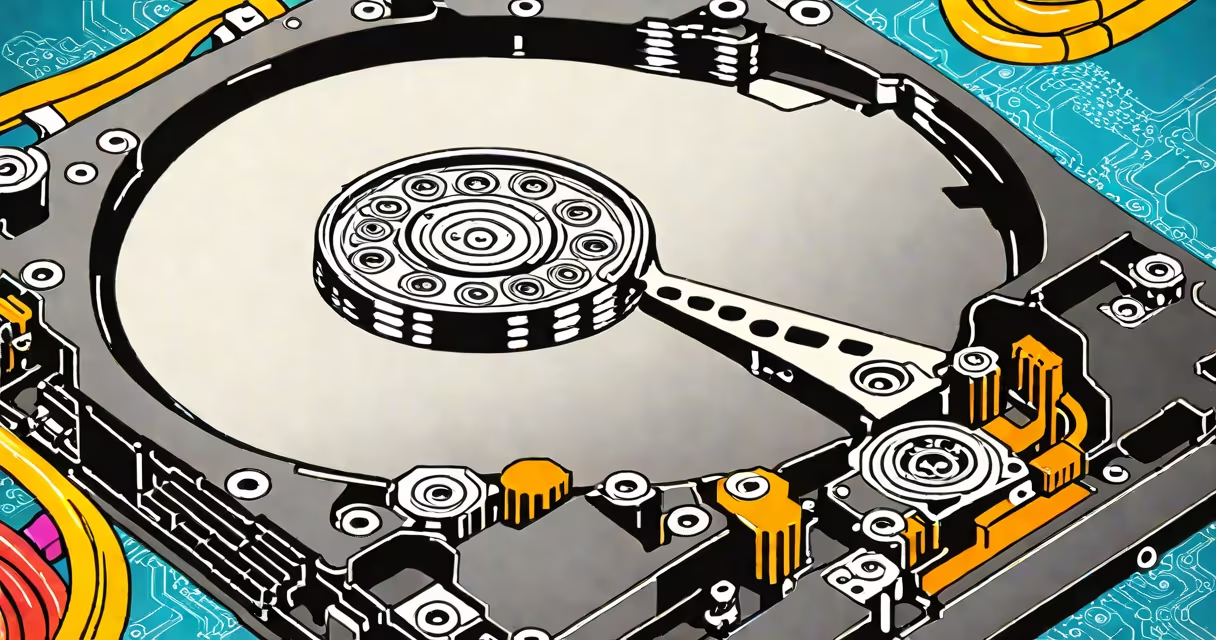
A SATA hard disk is a mechanical storage device that uses spinning magnetic platters and read/write heads to store and retrieve digital data, connected to a computer via the Serial ATA (SATA) interface. It operates at speeds ranging from 150 MB/s to 600 MB/s depending on the revision, and remains widely used in desktops, servers, and external enclosures.
SATA hard disks are distinct from solid-state drives (SSDs), which use flash memory and have no moving parts. While SSDs offer faster access times and better durability, SATA hard disks provide higher capacity at lower cost per gigabyte. They are ideal for storing large files such as videos, backups, and archives.
The SATA interface was introduced in 2003 as a successor to PATA (Parallel ATA), offering faster data transfer, thinner cables, and hot-swapping support. Modern systems still include SATA ports, making these drives compatible with most motherboards from the last two decades.
Data is stored on rotating platters coated with magnetic material. A read/write head floats nanometers above the surface, detecting or altering magnetic polarity to represent binary data. As the platter spins at 5,400 RPM, 7,200 RPM, or 10,000 RPM, the head accesses sectors sequentially.
When the system requests a file, the drive's controller calculates the physical location of the data, positions the head over the correct track, and waits for the desired sector to rotate under it. This rotational latency averages 4-8 milliseconds, depending on speed. Once aligned, data transfers at up to 6 Gbps (SATA III).
For example, reading a 1 GB video file from a 7,200 RPM SATA drive takes approximately 15 seconds, assuming sustained transfer rates near 70 MB/s. This is slower than NVMe SSDs but sufficient for bulk storage tasks.
SATA hard disks come in three performance tiers based on interface version and spindle speed:
| Interface Version | Max Transfer Rate | Typical Use Case | Common Drive Speed |
|---|---|---|---|
| SATA I (1.5 Gbps) | 150 MB/s | Older systems, basic storage | 5,400 RPM |
| SATA II (3.0 Gbps) | 300 MB/s | General computing, media libraries | 5,400-7,200 RPM |
| SATA III (6.0 Gbps) | 600 MB/s | High-capacity storage, gaming, editing | 7,200 RPM |
Most modern SATA hard disks use SATA III and spin at 7,200 RPM for optimal balance between speed and power efficiency. Enterprise models may reach 10,000 RPM for database workloads, though they consume more power and generate more heat.
Capacity ranges from 500 GB to 20 TB. A 20 TB model from Seagate Barracuda offers 100,000 hours of rated reliability and 24/7 operation, suitable for NAS devices and backup servers.
SATA hard disks remain standard in desktop PCs, home servers, and network-attached storage (NAS) units due to their low cost per terabyte. A 4 TB SATA drive costs around $70, while a comparable 4 TB NVMe SSD exceeds $150.
They're preferred for long-term data retention. For example, a photographer backing up 10 years of RAW images uses multiple 8 TB SATA drives in a RAID range, reducing cost and energy use compared to SSDs.
External enclosures often use SATA drives because of their widespread availability and compatibility. A USB 3.0-to-SATA adapter allows a 3.5-inch internal drive to function as a portable backup solution.
Many assume SATA hard disks are obsolete. That's incorrect. While SSDs dominate boot drives and high-performance applications, SATA HDDs still lead in capacity and price efficiency. According to Backblaze, SATA drives accounted for 68% of their data center storage in 2023, despite the rise of flash-based solutions.
Another myth is that SATA drives are inherently slow. The bottleneck lies in mechanical access time, not the interface. Even with SATA III's 600 MB/s limit, a 7,200 RPM drive achieves ~120 MB/s sustained throughput in real-world use due to seek delays and rotational latency.
Some confuse SATA with M.2. SATA M.2 drives exist but are physically smaller and use the same interface. They're not faster than 2.5-inch SATA SSDs unless paired with a PCIe interface. A 2.5-inch SATA drive outperforms a SATA M.2 drive in sequential writes due to better thermal management and larger cache.
I configured a home media server using four 8 TB SATA hard disks in a RAID 5 range. The system runs on a motherboard with six SATA III ports and a 120 W PSU. Each drive spins at 7,200 RPM, providing ~140 MB/s aggregate bandwidth.
This setup delivers 32 TB of usable space at ~$2.20 per TB, far cheaper than SSD alternatives. The trade-off is longer startup times and occasional noise during heavy access.
A SATA hard disk is a cost-effective, high-capacity storage solution that relies on mechanical components and the SATA interface for data transfer. It remains essential for archiving, backups, and media servers where speed is secondary to volume and affordability.