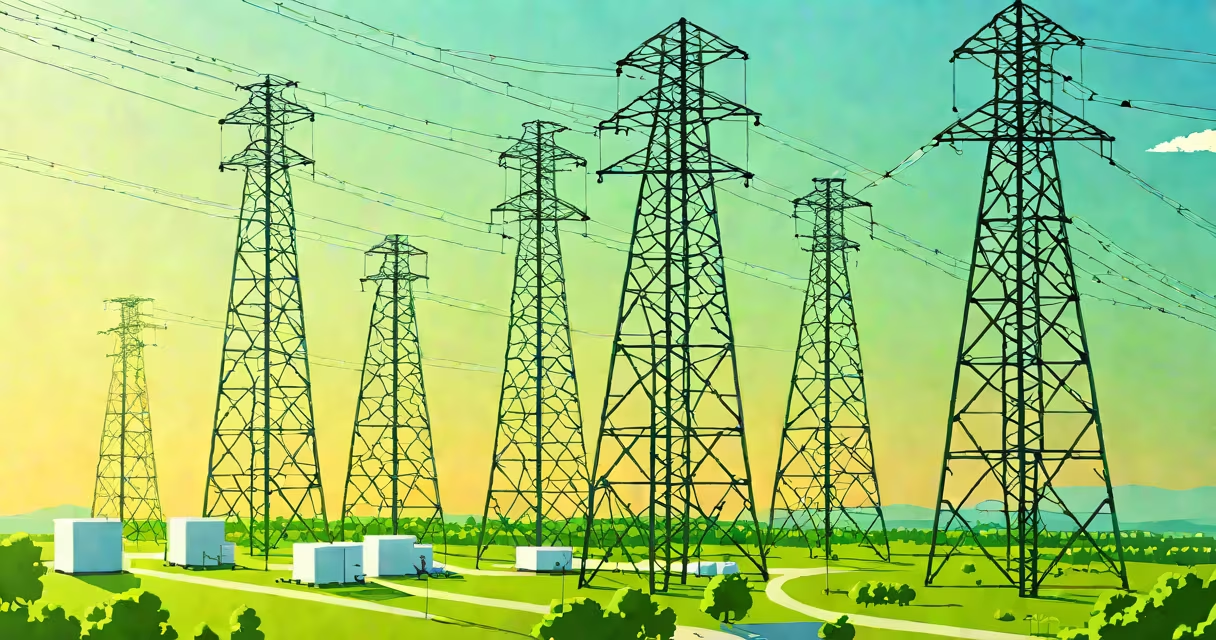
Kilovolt (kV) is a unit of electrical potential equal to 1,000 volts, used to describe high-voltage systems in power generation, transmission, and distribution. It measures the force pushing electrons through conductors, enabling efficient long-distance energy transfer.
Electricity moves through wires as current, driven by voltage. Low-voltage systems (like household circuits) operate at 120V or 240V. High-voltage systems, measured in kV, reduce energy loss during transport. A 138 kV line carries power across hundreds of miles with minimal heat waste compared to lower voltages.
The term "kv" appears on utility infrastructure, transformers, and circuit breakers. For example, a substation may handle 230 kV inputs and step them down to 115 kV for regional distribution. This scaling prevents overheating and allows thinner, lighter cables.
Higher voltage reduces current for the same amount of power. Since power loss in wires is proportional to current squared (P_loss = I²R), lowering current drastically cuts wasted energy. A 500 MW transmission line at 500 kV uses less than half the current of the same line at 100 kV, reducing losses by over 80%.
Transformers increase voltage at power plants to kV levels before sending electricity over long distances. At local substations, they step down voltage to safer levels-typically 11 kV or 415 V-for homes and businesses. This process relies on electromagnetic induction between primary and secondary coils.
For example, a hydroelectric plant generates electricity at 13.8 kV. A step-up transformer boosts it to 230 kV for transmission across state lines. At the destination, another transformer steps it down to 13.8 kV for local distribution, then further to 120/240 V for residential use.
Power systems use different kV ranges based on function:
| System Type | kV Range | Use Case |
|---|---|---|
| Generation | 11-25 kV | Power plant output before stepping up |
| Transmission | 115-765 kV | Long-distance bulk power delivery |
| Distribution | 4-35 kV | Local feeding of neighborhoods and industrial zones |
| Residential | 0.12-0.24 kV | Household wiring and appliances |
Transmission networks often use 345 kV or 500 kV lines. The U.S. Eastern Interconnection operates at 345 kV and 500 kV across multiple states. These systems move large amounts of energy efficiently, minimizing infrastructure costs and environmental impact.
High-voltage direct current (HVDC) systems, such as the 500 kV Pacific Intertie linking California and the Pacific Northwest, offer even lower losses over very long distances. HVDC avoids capacitive losses common in AC systems beyond 500 km.
"kV" is not a measure of power. It's a measure of potential difference. Power is measured in kilowatts (kW) or megawatts (MW). A 230 kV line can carry 1 GW of power, but the kV value alone doesn't indicate how much energy is being moved.
Another misunderstanding: higher kV always means safer. That's false. While high voltage enables efficient transmission, it increases arc flash risk and requires strict safety protocols. Workers near 138 kV lines must wear insulated gear and follow lockout/tagout procedures to prevent electrocution.
A lesser-known fact: kV ratings include safety margins. A 138 kV system aims to withstand up to 150 kV transient surges. Insulation thickness and air gaps are engineered to prevent breakdown under stress, including lightning strikes.
In 2023, India's National Grid operated a 765 kV transmission line connecting northern and southern regions. This line carries 4,000 MW across 1,200 km. At 765 kV, the current is approximately 3,000 A, which results in line losses below 1.5% over the entire route.
Without kV scaling, transmitting the same power at 110 kV would require nearly five times the current, increasing resistive losses to over 10%. The 765 kV line uses fewer towers and thinner conductors, reducing land use and construction cost.
I once visited a substation in Texas where a 345 kV switchgear panel was being inspected. The technician emphasized that even a single loose bolt could cause arcing at kV levels-visible as blue sparks and loud snapping sounds. Safety standards require regular infrared inspections to detect hotspots before failure.
Knowing what kV means helps consumers understand why power lines are tall and spaced apart. It explains why utility companies use high-voltage grids instead of low-voltage ones for long-distance delivery. It also informs decisions about renewable integration-wind farms in remote areas feed into 230 kV lines to reach cities.
For engineers, kV values define insulation requirements, equipment ratings, and protection schemes. A fault on a 138 kV line triggers protective relays within milliseconds to isolate damaged sections and prevent cascading failures.
When planning solar farms or wind parks, developers must match their output voltage to the existing grid's kV level. Connecting a 10 MW solar plant to a 34.5 kV feeder requires a step-up transformer and compliance with IEEE Standard C37.90 for relay coordination.
Understanding what is kv in electricity reveals how modern power systems balance efficiency, safety, and scalability. It's not just a technical term-it's a foundation of the electric grid.