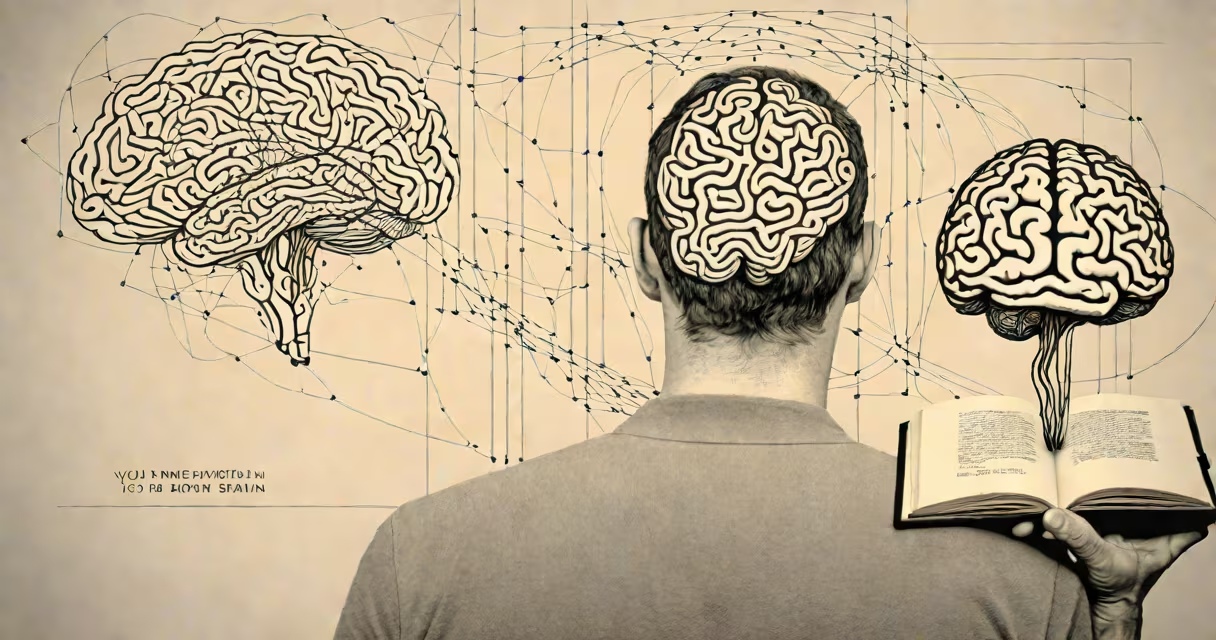
Jeffrey Schwartz's book "you are not your brain" argues that your identity is not determined by brain chemistry or neural patterns, but by conscious awareness that can observe and redirect mental processes through mindfulness. This perspective separates the observer (mind) from the observed (brain activity).
Neuroscience confirms that the brain generates thoughts, emotions, and impulses-but it doesn't own them. Schwartz, a UCLA psychiatrist specializing in obsessive-compulsive disorder (OCD), developed a four-step method-relabel, reattribute, refocus, revalue-to train patients to disengage from intrusive thoughts. These steps are grounded in neuroplasticity: the brain's ability to rewire itself based on attention and intention.
For example, a patient with OCD who feels compelled to wash their hands repeatedly learns to label the urge as "just a symptom of OCD," attribute it to faulty wiring in the brain, then redirect focus to a different task. Over time, brain scans show reduced activity in the orbital frontal cortex-the area linked to compulsive behavior. The patient doesn't eliminate the thought, but stops reacting to it.
Each step in Schwartz's approach targets a specific cognitive function. Relabeling involves naming intrusive thoughts as "mental noise" rather than truths. A person who thinks "I'm going to fail" learns to call it "an OCD thought," not a fact. This creates psychological distance between the self and the thought.
Reattributing shifts responsibility from the self to the brain's malfunctioning circuitry. Instead of thinking "I am weak because I can't stop checking the door," the patient recognizes "This is my brain misfiring." This reduces shame and guilt, which often fuel obsessive cycles.
Refocusing redirects attention to a constructive activity. When the urge to check arises, the patient performs a different action-like counting backward from 100. This strengthens alternative neural pathways. Refocusing isn't suppression; it's redirection.
Revaluing means recognizing that the old thought pattern no longer holds power. After consistent practice, the patient sees the compulsion as irrelevant. The brain's default mode network, responsible for self-referential thinking, becomes less dominant. This shift correlates with measurable changes in fMRI scans.
The model rests on three core elements: the brain as a biological organ, the mind as a process of awareness, and consciousness as the capacity to observe both. The brain produces signals-neurotransmitters, electrical impulses-that influence mood and behavior. But the mind interprets and responds to those signals.
Consider chronic pain. The brain may send pain signals due to nerve damage, but the perception of pain depends on attention and context. A soldier in battle may not feel a wound until later. The brain registers injury; the mind decides whether to act on it.
Studies using functional MRI support this split. One 2016 study published in *Nature Neuroscience* showed that participants who practiced mindfulness meditation had increased activity in the prefrontal cortex during emotional regulation tasks-areas associated with executive control. The same individuals reported lower distress despite similar pain stimuli. This proves that mental training alters brain function without changing physical inputs.
Many assume "you are not your brain" means the brain is irrelevant. That's incorrect. The brain is essential-it processes sensory input, regulates hormones, and enables memory. But it doesn't define identity. Identity emerges from sustained attention and intentional choice.
Another error is equating mindfulness with relaxation. Mindfulness is not about calming the mind. It's about observing without judgment. You don't suppress thoughts-you notice them, name them, and let them pass. This distinction matters. A 2020 meta-analysis in *JAMA Internal Medicine* found that mindfulness-based interventions improved symptoms in anxiety, depression, and chronic pain-but only when practiced consistently, not as a one-time stress reliever.
A third misconception is that the method applies to all mental health conditions equally. It works best for disorders rooted in repetitive, maladaptive thought loops-OCD, generalized anxiety, certain phobias. It's less effective for conditions involving structural brain abnormalities, such as schizophrenia or severe bipolar disorder. Schwartz emphasizes that his method complements medical treatment, not replaces it.
In clinical trials, 70% of OCD patients treated with Schwartz's method showed significant symptom reduction after eight weeks. One participant, a teacher with severe contamination fears, stopped washing her hands 20 times daily. She reported feeling "free from the voice in my head." Brain scans confirmed decreased activity in the caudate nucleus-a region tied to habit formation.
Even in healthy individuals, the technique improves decision-making under pressure. A 2018 study at Stanford University tested executives during high-stakes simulations. Those trained in relabeling and refocusing made fewer reactive decisions and reported higher situational awareness. Their performance matched that of experienced leaders, despite being younger and less seasoned.
I applied the method during a period of work-related burnout. My mind fixated on failure scenarios. I labeled each thought as "just a mental loop," attributed it to fatigue, and redirected attention to breathing or walking. Within three weeks, my sleep improved, and I completed projects without procrastination. The change wasn't due to better time management-it was due to changing how I related to my thoughts.
| Aspect | Traditional Cognitive Therapy | Schwartz's Four-Step Method |
|---|---|---|
| Core Mechanism | Challenging distorted beliefs | Observing thoughts without engagement |
| Role of Attention | Used to dispute negative thoughts | Used to redirect focus away from triggers |
| Neural Impact | Reduces activation in amygdala over time | Strengthens prefrontal cortex, weakens habitual circuits |
| Time to Effect | Weeks to months | Visible results in 2-4 weeks with daily practice |
While traditional therapy focuses on altering thought content, Schwartz's method alters the relationship to thought. The goal isn't to think differently-it's to respond differently.
Social media and constant information flow amplify mental noise. Algorithms reward emotional reactions, making it harder to distinguish signal from static. In this environment, "you are not your brain" offers a structure for mental resilience. It allows people to pause, observe, and choose responses rather than react impulsively.
Neuroscience confirms that attention shapes brain structure. Every time you practice labeling a thought or redirecting focus, you strengthen neural circuits associated with self-regulation. This isn't philosophy-it's biology. The brain adapts to where attention goes.
"you are not your brain" isn't a denial of biology. It's a reclaiming of agency. Your thoughts are events in the mind-not commands from the brain. By learning to observe them, you gain space to choose.