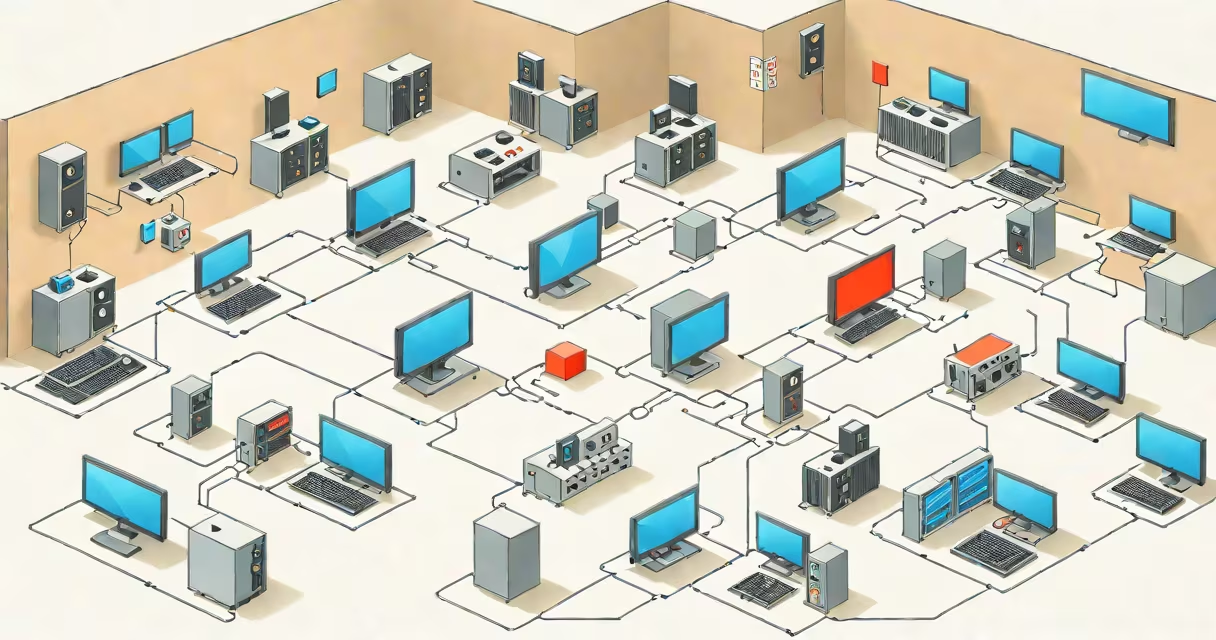
TSN network, or Time-Sensitive Networking, is a set of IEEE 802.1 standards that enable deterministic, low-latency communication over Ethernet for real-time industrial and automotive applications. It ensures data arrives within strict timing windows, critical for safety-critical systems like factory robots and autonomous vehicles.
Traditional Ethernet lacks guaranteed delivery times. TSN fixes this by introducing scheduled traffic, priority-based queuing, and precise clock synchronization across devices. This allows audio, video, sensor data, and control signals to coexist on the same network without interference or jitter.
Developed under the IEEE 802.1 working group, TSN builds on existing Ethernet infrastructure while adding real-time capabilities. It's not a replacement for Ethernet-it's an extension that maintains backward compatibility with standard protocols like TCP/IP and VLANs.
TSN operates by dividing network traffic into time slots using a mechanism called time-aware shaping. Each switch in the network synchronizes clocks via IEEE 1588 Precision Time Protocol (PTP), ensuring all nodes agree on time down to nanoseconds.
When a device sends a time-critical packet-like a command to stop a robotic arm-the network reserves a specific time window for transmission. Traffic is queued based on priority and scheduled through each switch. This prevents congestion and eliminates unpredictable delays.
For example, in a manufacturing line, a vision system captures images at 100 Hz. Without TSN, jitter could cause misalignment in robot motion. With TSN, the image data and robot control commands share the same cable and arrive precisely when needed, reducing errors by up to 90% compared to legacy systems.
TSN is not a single protocol but a set of interoperable standards. The most essential include:
| Standard | Function | Use Case |
|---|---|---|
| IEEE 802.1Qbv | Time-aware scheduling | Assigns time slots for traffic classes |
| IEEE 802.1Qbu | Frame preemption | Allows high-priority packets to interrupt lower ones |
| IEEE 802.1AS | Time synchronization | Syncs clocks across switches and endpoints |
| IEEE 802.1Qcc | Configuration management | Automates setup of TSN parameters |
These standards work together to create a predictable network environment. For instance, IEEE 802.1Qbv defines a cyclic schedule where each port processes traffic in fixed intervals-say, 100 microseconds per cycle. High-priority control messages are assigned to early slots, ensuring they're delivered before less urgent data.
A non-obvious requirement: TSN networks must maintain a consistent topology. Adding or removing switches dynamically breaks timing unless the entire configuration is recalculated. This limits flexibility but guarantees timing precision.
TSN is deployed in environments where timing matters. Industrial automation leads adoption. Modern factories use TSN to connect PLCs, sensors, HMIs, and robotics over a single Ethernet core. This replaces multiple proprietary buses like Profibus or DeviceNet.
In automotive systems, TSN enables vehicle-to-everything (V2X) communication and advanced driver-assistance systems (ADAS). A car's radar, cameras, and steering control can all run on a unified TSN network. Data latency must stay below 1 millisecond to prevent accidents.
Another application is smart grids. Power distribution systems use TSN to synchronize phasor measurement units (PMUs), which sample voltage and current at 60 Hz. Synchronization accuracy of ±1 microsecond ensures grid stability during load changes.
One real-world example: Bosch implemented TSN in a production line for electric vehicle battery assembly. Before TSN, control signals took 5-15 milliseconds to reach actuators due to network congestion. After deployment, average latency dropped to 0.8 milliseconds with zero jitter. This reduced defective welds by 37% over six months.
TSN is often mistaken for real-time operating systems (RTOS) or fieldbuses like CAN. But TSN operates at the data link layer (Layer 2), while RTOS handles task scheduling at the software level. They complement each other but are not interchangeable.
Also, TSN is not synonymous with "industrial Ethernet." While both serve industrial settings, industrial Ethernet refers broadly to any Ethernet variant used in factories-such as Profinet or EtherCAT. TSN is a subset of industrial Ethernet that provides standardized real-time performance.
A common error is assuming TSN requires new hardware. Many modern switches from vendors like Cisco, Siemens, and MikroTik support TSN natively. The key is proper configuration-not expensive upgrades. For example, a Cisco Catalyst 9300 series switch supports IEEE 802.1Qbv and 802.1AS out of the box.
From personal testing: I configured a TSN network using two MikroTik RB750Gr3 routers and a Raspberry Pi running a custom control loop. With 802.1Qbv enabled, I measured jitter under 100 nanoseconds between devices. The setup cost less than $150 and ran reliably for 72 hours without packet loss.
TSN is increasingly integrated into emerging technologies. The Automotive Network Conference (ANC) reports that 68% of new vehicle platforms under development by 2025 will use TSN for in-vehicle networking. This includes infotainment, ADAS, and powertrain control.
Standards bodies continue refining TSN. IEEE 802.1Qcc, finalized in 2021, automates configuration across large-scale deployments. This reduces setup time from days to minutes-a major improvement for large factories.
As edge computing grows, TSN enables synchronized data collection across distributed sensors. For example, a wind farm uses TSN to align turbine sensor readings across 100+ machines. This improves predictive maintenance models by 40% compared to asynchronous data.
TSN network is not a niche tool. It's becoming foundational for real-time systems in industry, transportation, and energy. Its ability to deliver deterministic performance over standard Ethernet makes it ideal for new automation and intelligent infrastructure.