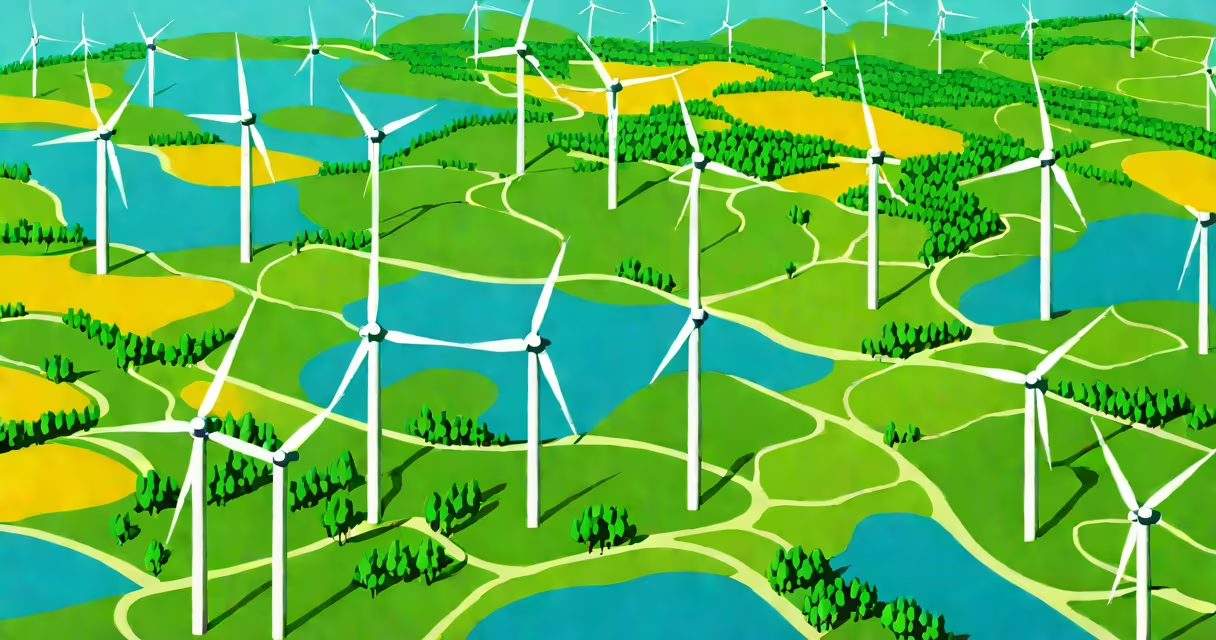
Wind electricity is generated when wind spins turbine blades connected to a generator, converting kinetic energy into electrical current. This process relies on aerodynamic design, electromagnetic induction, and grid integration. Modern wind farms produce enough power to supply tens of thousands of homes.
Wind moves air particles, creating kinetic energy. When wind hits the angled blades of a turbine, it causes rotation. The blades are attached to a central shaft inside the nacelle-the housing atop the tower. As the shaft spins, it drives a gearbox that increases rotational speed. This high-speed shaft connects to a generator, which uses electromagnetic induction to produce alternating current (AC).
The generator's output is sent through cables down the tower to a transformer. The transformer adjusts voltage levels for efficient transmission over power lines. Once synchronized with the grid, electricity flows to homes and businesses. A control system monitors wind speed and blade pitch, adjusting angles to maintain optimal performance and prevent damage during high winds.
For example, a single 2.5-megawatt turbine operating at 40% capacity factor generates approximately 5.2 million kilowatt-hours annually. That's enough to power around 460 average U.S. households per year, according to the U.S. Department of Energy.
Each element in a wind turbine plays a critical role in energy conversion. The rotor consists of three blades made from fiberglass-reinforced polymer. These materials provide strength and flexibility under stress. Blade length varies-common sizes range from 50 to 80 meters-directly affecting swept area and energy capture.
The nacelle houses the drivetrain: gearbox, generator, and cooling systems. The gearbox increases rotational speed from the low 10-20 RPM of the blades to 1,000-1,800 RPM required by most generators. Direct-drive turbines eliminate the gearbox by using permanent magnets in the generator, reducing mechanical complexity and maintenance needs.
Below the nacelle, the tower supports the entire structure. Tubular steel towers typically stand between 80 and 120 meters tall. Height matters because wind speeds increase with altitude, improving efficiency. For every 10 meters of elevation gain, wind speed rises by about 10%, doubling the available power due to the cubic relationship between wind speed and energy.
| Component | Function | Typical Size/Spec |
|---|---|---|
| Blades | Convert wind kinetic energy into rotational motion | 50-80 m long, fiberglass composite |
| Generator | Change mechanical rotation into AC electricity | 2.5 MW capacity, permanent magnet or induction |
| Grid Connection | Integrate generated power into the regional electrical network | High-voltage transmission lines, 115-230 kV |
Wind electricity is deployed globally, with leading producers including China, the United States, Germany, India, and Brazil. In the U.S., Texas leads in installed wind capacity, generating over 30 gigawatts-enough to power nearly 10 million homes. Denmark produces over 50% of its electricity from wind, demonstrating scalability in national grids.
Wind is preferred for its low operational cost and minimal emissions. Unlike fossil fuel plants, wind turbines emit no carbon dioxide during operation. According to the International Renewable Energy Agency (IRENA), onshore wind has a lifecycle greenhouse gas emission of 11 grams CO₂ equivalent per kWh-less than 1% of coal's 820 g/kWh.
A common misconception is that wind turbines require constant wind. In reality, they operate efficiently within a specific wind speed range-typically 12 to 25 km/h (7-15 mph). Below 3 m/s, turbines don't generate power. Above 25 m/s, they automatically shut down to avoid damage. Modern forecasting tools predict wind patterns hours in advance, enabling grid operators to balance supply and demand.
Wind electricity differs from solar and hydroelectric generation in both mechanism and intermittency. Solar panels convert sunlight directly into DC electricity via photovoltaic cells. Hydroelectric plants use falling water to spin turbines. Wind relies solely on atmospheric movement, making it variable but highly predictable over time.
Unlike nuclear or coal plants, wind doesn't require fuel or continuous human oversight. However, it requires large land areas or offshore locations. Offshore wind farms, such as Hornsea One in the UK, span over 400 square kilometers and generate 1.2 gigawatts-equivalent to powering 1.3 million homes.
One non-obvious fact: wind turbines contribute to local climate effects. Research published in *Nature Communications* (2021) found that large-scale wind farms can alter near-surface temperature and humidity patterns due to increased mixing of air layers. While localized, these changes show the environmental trade-offs involved in scaling renewables.
During a visit to a wind farm in Iowa, I observed how turbines adjust blade pitch in real time. On a calm morning, blades rotated slowly. As wind picked up, pitch changed to maintain consistent rotor speed, keeping output stable despite fluctuating wind. This changing adjustment ensures efficient energy capture across variable conditions.