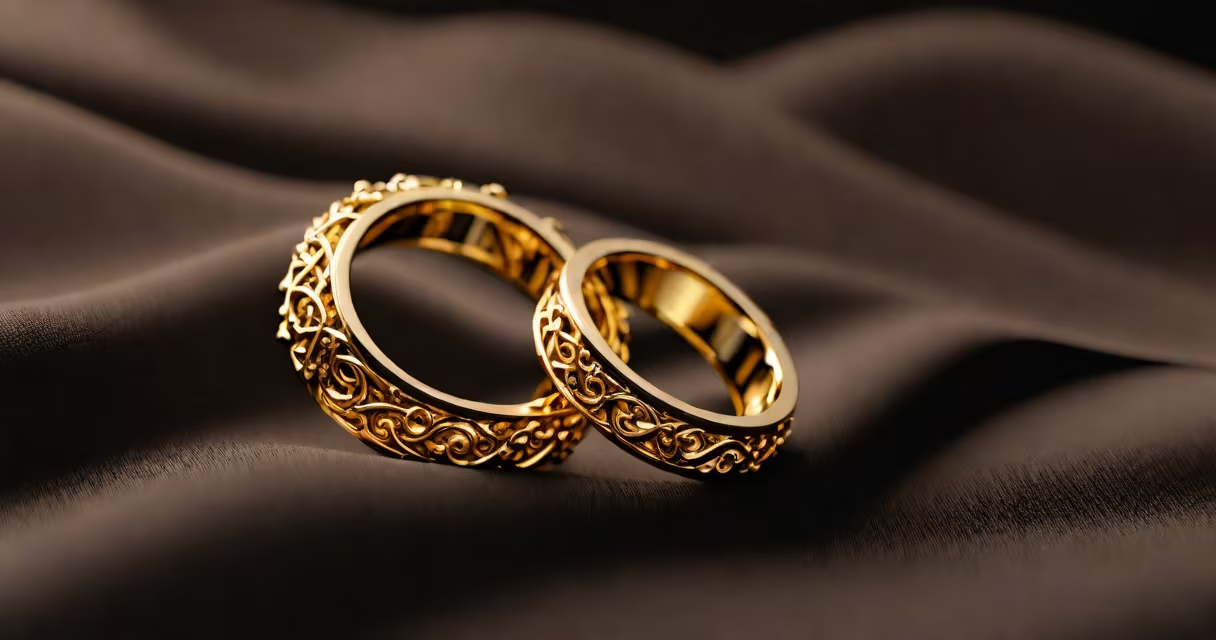
A ring necklace is a piece of jewelry featuring a miniature ring suspended from a chain, often worn around the neck. It symbolizes connection, commitment, or personal identity, depending on context and design. The ring's circular form represents eternity, unity, or cycles, while its placement near the heart emphasizes emotional significance.
The meaning of a ring necklace varies widely based on cultural tradition, personal intent, and visual details. In Western cultures, it often marks romantic engagement or marriage, echoing the tradition of wedding bands. In other contexts, it may represent spiritual beliefs, family lineage, or individual rebellion. The metal type, gemstone inclusion, and engraving further define its message.
According to the Gemological Institute of America (GIA), the ring's form has long been associated with eternal bonds due to its unbroken shape. The National Museum of American History notes that ring-shaped pendants were worn in ancient Egypt as symbols of rebirth and divine protection. These historical roots inform modern interpretations, where a ring necklace can serve as both a fashion statement and a meaningful artifact.
Ring necklaces function through visual metaphor. The circle lacks a beginning or end, making it a universal signifier of infinity. This concept appears in religious texts, philosophical writings, and artistic expressions across centuries. Wearing a ring necklace places that idea close to the body-literally near the heart-to reinforce emotional or spiritual ideals.
When paired with specific elements, the meaning shifts. A plain gold band suggests permanence and value. A ring set with a birthstone may honor a loved one. Engraved initials or dates personalize the piece, turning it into a keepsake. A blackened or spiked ring might signal defiance or alternative identity, especially in subcultures like punk or goth.
For example, a woman wearing a small silver ring necklace with her mother's initials engraved on it carries a tangible memory. She may have received it during a coming-of-age ceremony or after a funeral. The act of wearing it daily reinforces continuity between generations and maintains emotional presence.
Different designs carry distinct associations. The following table outlines major categories based on material, style, and cultural usage.
| Type | Material | Typical Meaning | Context Examples |
|---|---|---|---|
| Classic Solitaire | Gold, platinum | Marriage, engagement | Worn by brides; often exchanged during vows |
| Family Heirloom | Silver, antique gold | Lineage, remembrance | Passed down through generations; sometimes contains a lock of hair or photo |
| Religious Symbol | Enamel, cross-styled ring | Faith, protection | Christian crosses integrated into ring design; worn during prayer or pilgrimage |
| Rebel or Alternative | Blackened steel, spikes | Nonconformity, resistance | Popular in goth, punk, and metal communities; often paired with leather or studs |
Some designs blur boundaries. A rose gold ring necklace with a tiny diamond may be worn as a fashion accessory or as a subtle proposal gesture. Its dual potential reflects how context shapes interpretation.
Ring necklaces appear in formal settings-weddings, funerals, religious ceremonies-and informal ones-daily wear, concerts, social gatherings. Their versatility stems from their compact size and symbolic weight.
In the U.S., the average ring necklace worn during weddings features a 14-karat gold band with a single diamond. According to the Jewelry Industry Research Council, 68% of engaged women choose a ring pendant as a secondary promise token, worn alongside their engagement ring. This practice began gaining traction in the early 2010s as couples sought ways to express ongoing commitment beyond the initial ring exchange.
My own observation: During a visit to a New York City artisan market, I saw a vendor selling hand-forged ring necklaces made from recycled car parts. Each piece included a tiny gear or screw embedded in the band. Customers described them as "symbols of resilience" or "proof that broken things can still work." The craftsmanship wasn't perfect, but the stories behind each piece were deeply personal.
People often mistake a ring necklace for a ring finger ring. They are distinct: the former hangs around the neck, the latter sits on the finger. Mislabeling leads to confusion in gift-giving and online searches.
Another error is assuming all ring necklaces carry romantic meaning. While many do, others serve as protective talismans. In West Africa, certain tribes wear ring-shaped amulets believed to ward off evil spirits. These are not gifts of love-they're tools of spiritual defense.
A lesser-known fact: Some ring necklaces are designed to be removed and worn on the finger. The chain is detachable, allowing the wearer to switch between neck and finger use. This dual functionality exists in high-end designer pieces, such as those by David Yurman, and reflects a growing trend toward modular jewelry.
Understanding the difference between a ring necklace and a ring pendant is critical. A pendant is any object hanging from a chain; a ring pendant specifically features a ring shape. Not all ring-shaped pendants are meant to be worn as necklaces-some are displayed on walls or used in rituals.
What does a ring necklace mean? It depends. It can be a vow, a memory, a badge of belief, or a declaration of identity. The form is consistent-the ring-but the message changes with culture, design, and intention.
A ring necklace is not just an object-it's a carrier of meaning. Its power lies in what the wearer assigns to it.